
The title of this article is quite a mouthful, and it promises you more than even a candidate for public office ever dared. Well, I'm not a candidate for public office, and I dare. I taught Advertising and Marketing for almost two years before the theme of this article occurred to me. It may well be the most original idea I’ve ever had.
Advertisers know that nobody buys a product or service because he wants that product or service. He buys it because he wants a benefit that the product or service seems to offer. The advertiser, then, sells products by selling benefits. Hidden away in that basic observation is the secret of how each of us can raise our living standards, spend less money, enjoy better health, and practice better environmental responsibility.
Let me give you a few more examples. People buy air conditioners because they want comfort. They buy ballpoint pens, usually because they want help in remembering something. They buy cars to get from point A to point B, though they may also buy a car to gain the approval of others—approval that may be leveraged into tangible benefits. Judging from the content of beer commercials, it seems that purchases of beer have less to do with refreshment and flavor than they have to do with having fun.
Your brain has a kind of filter that acts like a guard standing watch at the gate. When someone presents a message at the gate, the guard looks at it to decide whether the message is true. If the guard accepts it as true, the message is allowed to enter a waiting room (soft wiring) where it’s still seen as “another person’s” message. After a time, the message is either dismissed, or it’s given a job as an accepted fact in your brain’s hardwiring.
There is, however, a way to fool the guard at the gate: The message is presented as entertainment and not a message. Since your brain likes entertainment, the embedded message is admitted and immediately becomes part of your brain’s hardwiring. For that reason, advertisers disguise their sales pitches as entertainment.
Advertisers also pull a sleight of hand. First, they try to get you all excited about getting a certain benefit. Then they use entertainment in a way that’s supposed to cause you to think that the only way you’ll get the benefit is by buying their product.
In the video commercial below, a Nokia cell phone is presented in a way as to suggest that it offers people a unique benefit. If you look at it logically, though, you’ll find that all it says is that you can use a Nokia cell phone to take pictures and send the pictures to someone who has a cell phone with similar functions. There's nothing new or unique about that. I believe that most cell phones already have those functions.
In the allegorical novel Gulliver's Travels, the king of Lilliput walked with a limp because the heel of one shoe was a sixteenth of an inch higher than the heel of the other shoe. To a very, very small person, that's a big difference.
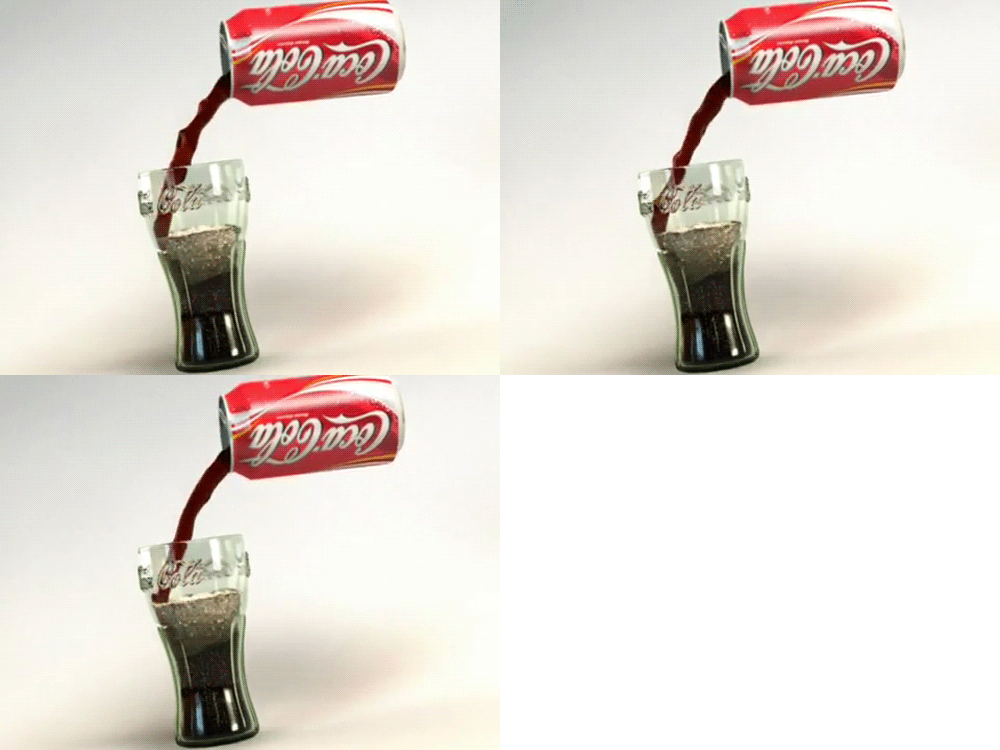
Advertisers—whether commercial, political, or other—are in the business of making minuscule differences seem vast. While target consumers are focused on a very few, nearly identical products, they tend to lose sight of countless other options. The "cola wars" of a few years ago caused target consumers to focus on two nearly identical forms of sugared water, at the expense of endless other possibilities, most of which had nothing to do with sugared water.
Returning to the Coca Cola example, I said that advertisers try to con you into thinking that you'll get the benefits you want only by buying their brand. You may be thinking, Oh, I’m not that gullible. I don’t have to buy a Coke. I can buy a root beer, a can of lemon tea, a can of coffee, an athletic drink, or any one of hundreds of other drinks.
Returning to the Coca Cola example, I said that advertisers try to con you into thinking that you'll get the benefits you want only by buying their brand. You may be thinking, Oh, I’m not that gullible. I don’t have to buy a Coke. I can buy a root beer, a can of lemon tea, a can of coffee, an athletic drink, or any one of hundreds of other drinks.

Is sugared water the only way you can get refreshment, flavor, and quick energy? More to the point, is sugared water the best way for you to get refreshment, flavor, and quick energy?
Processed sugar makes you thirsty soon after you’ve drunk it. Your energy level drops twenty minutes after a temporary boost. Most of the price of a container of sugared water comes from manufacturing the container. The sugared water itself costs next to nothing. Pollution and waste are major byproducts of the manufacture and transport of sugared water.
Chances are, you know hours in advance that, at some time during the day you’ll want refreshment, flavor, and quick energy. Chances are, there will be many days when you’ll want those benefits. A little preparation on one occasion can provide you with the benefits you’ll want on all such occasions.

This combination of green tea and raisins does a much better job of giving me the benefits of refreshment, flavor, and quick energy. It’s also healthier for me. It costs only a fraction of the cost of a Pepsi or Coke. It’s also more environmentally responsible.
Where did I get the bottle for the tea? Not from the camping supply store. That one was too bulky and cost around US$15.00. Not from the school supply section of Carrefour. That one cost around US$4.50, was easily breakable, and looked as though it would leak. As a last resort, I went to the dairy section of Carrefour and found one that was perfect. It was the right size, shape, and weight. It was durable enough to last three years and counting, and it cost less than US$2.00.
There was a bonus: It was full of yoghurt. I didn’t have to pay anything for the yoghurt. As long as I paid for the bottle, the yoghurt was free.
Forget what advertisers tell you. When you ask yourself what brand you should buy, you’re limiting yourself to either the advertised brand or something almost just like it.
Instead, ask yourself, “What benefits do I want?” Then ask yourself, “What’s the best way to get those benefits?” In most cases, you’ll select something more beneficial, healthier, cheaper, and more environmentally responsible.

If an Emberá, a Trobriand Islander, or any one of a billion or so other rainforest natives and other tropical peoples has a chance to read this, he'll probably laugh at the heavy clothing the man in the photo at right is wearing, as if he were afraid of freezing to death. (Wouldn't a loincloth be cooler?) By the standards of many rainforest natives, the woman's manner of dress must be puzzling. It's considered indecent for a woman to expose her thighs; and she's too warmly dressed from the waist up. (Wouldn't a loose-fitting skirt be cooler? If she has to wear a top, why not a loose-fitting tee shirt?) A billion or so people have no need of this article except as confirmation of how wasteful billions of other people really are, even as we pat themselves on the back for recycling things we never needed in the first place.
It's a dreadful mistake to assume that buying most of our products from corporations makes us more advanced than people who don't have to do so. In the composite photo below, the Emberás have better swimming facilities than the multimillionaire Al Gore. If our own rivers are too polluted for swimming, it's largely because of our purchasing habits. The Himbas' homes, made of clay and sticks, are naturally cooled, and at no expense. The palace in the photo employs fewer natural advantages and is shockingly wasteful in all other respects The Emberá and Trobriand villages are cooled at no cost via cross ventilation.
In case you're wondering about the photos below, the structure in the middle of the Trobriand village is for the environmentally friendly storage of yams, a staple crop. (How do you store your yams?) The Emberás use juice from a local berry to decorate their bodies and to ward off insects. The Himbas use clay as both decoration and sunscreen.

I've spent a few paragraphs on the folly of relying on sugared water to get refreshment, flavor, and quick energy; and a few other paragraphs on the folly of using air conditioners when all you really want is comfort. Let's quickly look at two others: ballpoint pens and hand-held computer games.
When it’s feasible, why not use a refillable mechanical pencil instead of a ballpoint pen? As a memory aid, a cell phone camera that you already have may also be a better option.
When it’s feasible, why not use a refillable mechanical pencil instead of a ballpoint pen? As a memory aid, a cell phone camera that you already have may also be a better option.
As for hand-held computer games, sometimes “nothing” is more beneficial than something. Taoism teaches that even “nothing” is something. Do we really need, for example, to fill our lives with stimulation when we’re more in need of silence?
Try my technique for a few weeks. Before buying something, decide what benefits you want and decide on the best way to get them.
I mentioned four advantages to using this technique: savings, more benefits, health, and a cleaner environment. There are more: a sense of freedom, more control over your life, and greater happiness and self esteem. Self esteem is the most satisfying form of status.
Back to Part 1: How to Raise Our Living Standards by Lowering the GDP
Back to Part 2: The Emperor's New Logo
Back to Part 3: Waste Products are Wasted Products
Back to Part 1: How to Raise Our Living Standards by Lowering the GDP
Back to Part 2: The Emperor's New Logo
Back to Part 3: Waste Products are Wasted Products


