Showing posts with label Michele Bachmann. Show all posts

Friday, December 30, 2011

Ron Paul's Chances: Seeing is Believing

     Supposedly, everybody "knows" that Ron Paul can't win, but nobody seems to know how he "knows," and we're not even supposed to question this assumption.  It's my experience that, when everybody "knows" something, and so forth, the assumption is the result of deliberate manipulation and is probably wrong.
      When was the last time you heard someone say, "I really like Herman Cain, but he can't win; so I'll vote for (name)"?  Oh, you never have?  Well, when was the last time you heard someone say that about Michele Bachmann, Jon Huntsman, Gary Johnson, Fred Karger, Andy Martin, Jimmy McMillan, Tom Miller, Buddy Roemer, Rick Santorum, Matt Snyder, or Vern Wuensche?  Oh, you never have?  
     Way back in 1979 and early 1980, I heard that all the time about Ronald Reagan: that we needed to vote for George H. W. Bush because Ronald Reagan didn't have a chance of beating Jimmy Carter.  Have you noticed that the only time you hear that canard at the national level is when a popular candidate poses a credible threat to one of the Establishment's hand-picked candidates?  
     Now we're hearing it about Ron Paul.  To test whether there was any truth to this canard, I consulted Google Trends.  No, Google Trends is not by any means a national polling service.
     You see, polling services ask people who may or not be interested in voting that year just how they intend to vote.  At least a third of them aren't going to vote, over two thirds of them won't vote in a primary, and fewer than that will go to the trouble of participating in caucuses, but they respond to surveys anyway.  Why not?  It doesn't cost them any effort to answer a question over the telephone.  
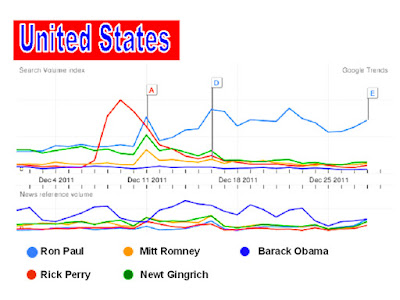
     No, Google Trends measures only two things: how much news coverage a person or topic gets during a given period, and how much Internet interest a topic or person generates during that same period.  People answer surveys whether they're interested in a candidate or not.  They search a candidate on the Internet only if their interested in him or her.
     Internet interest doesn't necessarily mean support, but there can be no support without interest.  Use discretion in reading these charts.  If there are fewer searches on Barack Obama than on Ron Paul, for example, Obama already generates enough reading material via the newspapers.
     Below, in order of the dates for Republican primaries from January 3 until Super Tuesday on March 6, are charts revealing Internet interest (over the last 30 days) in Ron Paul, Mitt Romney, Barack Obama, Rick Perry and Newt Gingrich in each of the primary and caucus states through Super Tuesday.  Sorry.  Google Trends measures only five entries at a time.  The first chart is for the United States as a whole.  The rest are for individual states.  The upper sets of lines are for Internet searches.  The lower sets are for news reports.
     Ron Paul should make an impressive showing in New Hampshire, but I'm not prepared to predict a win.
     I'm from South Carolina.  South Carolina is definitely Ron Paul country.  
     Because Maine is a caucus state, and Ron Paul tends to do well in caucuses, I think he'll do well in Maine.

Colorado
Minnesota
     Michele Bachmann will probably do well in Minnesota, but I'm confident that Ron Paul will win.


     The Super Tuesday primaries and caucuses are not winner-take-all contests.  Delegates will be assigned in proportion to the percentage of the votes each candidate receives.
     Because there was not enough Internet traffic for Alaska, I'm putting it on the same page as the results for Georgia.  The chart refers only to Georgia.  Alaska is a caucus state.  Ron Paul will win.  He'll also win in Idaho (below).
     Chalk up a win for Ron Paul in North Dakota.  The chart below is for Ohio.

     Unless the political climate in Vermont (below) has changed over the past four years, Vermont is not Ron Paul country.  Paul has the added disadvantage of Vermont being a primary state.  
     On the surface, Virginia looks very good for him, in spite of the big support for Romney in the Arlington area.  Since Romney and Paul are the only candidates on the ballot for Virginia, we can expect that Romney will pick up the Establishment vote (such as Gingrich's supporters), while Paul will garner the anti-establishment vote.  It should be interesting.
          I chose not to look at traffic for states after Super Tuesday because the primaries and caucuses prior to (and including) March 6 will heavily influence the dynamics of the remaining primaries.  Draw your own conclusions.
     How do you account for the stunning lack of interest in Romney, Perry, and Gingrich, even as opinion surveys show major support for these three candidates?  It appears that their "support" is mainly due to voter desire to find an alternative to Barack Obama, and that the corporate-owned media have these shallow "supporters" convinced that Ron Paul can't win.  If this is the case, then Google Trends is a far more reliable measure of Ron Paul's popularity than the opinion polls could ever be.
     Just ask yourself, when was the last time you heard an average voter say that he's voting for Romney, Gingrich, or Perry because he thinks that person will be good for the country?  Chances are, you never have.  That would explain why so few people seek information about them on the Internet.
     To secure the nomination, Ron Paul has only one further need.  People who say, "I like Ron Paul, but..." should get off their "buts" and place their votes where their hearts are.

Wednesday, August 17, 2011

Michele Bachmann Doesn't Believe Her Own Words. Why Should We Believe Them?

      Michele Bachmann is the Barack Obama of the 2012 presidential election cycle. The comparison goes to something more basic than their thin biographies, though their thin biographies are nonetheless worth a look.
     They were both trained to be lawyers. Both had unimpressive records in state senates before going to Washington. Obama served in the Illinois state from 1997 through 2004; Bachmann served in the Minnesota state senate from 2000 through 2006. Neither accomplished anything worth mentioning. Obama served as a U.S. senator from 2005 through 2008; Bachmann has been in the House since 2007. Neither accomplished anything worth mentioning. Both of them drew favorable national attention to themselves based solely on their words—words of hope and change that people wanted to hear and believe.
     Here’s where we get down to brass tacks. We know now, if we didn’t know it before now, that the words that got Barack Obama elected were lies. Unlike Michele Bachmann, Mr. Obama at least offered concrete policies and plans even if he didn’t believe his own words. Michele Bachmann offers nothing but words. Does Michele Bachmann believe her own words? If Michele Bachmann’s words are all she’s offering the American people as a reason for electing her President of the United States, then it’s worth checking to see if she believes them herself.
     One advantage we have as a lie detector is that Bachmann has been in Washington for less than four years. She hasn’t had as much time to perfect the art of faking sincerity.
     At least as early as 1978, and up to the present, behavioral psychologists have researched and written peer reviewed articles validating body language and face language. (For samples of articles or abstracts in social science citation index (SSCI) journals, see here, here, and here.) Experienced congressmen know very well that opponents (such as I) sometimes look for signs of lying, and experienced congressmen usually know how to disguise their lying more effectively than Michelle Bachmann does.
     Let me stress here that this is not a parlor game in which “X” always signals “Y” or something like that. Psychology and the human mind are more complex than that.  (In fact, not all liars signal their deceit in the same ways.)
     To give one example of unconscious signaling, when a person makes a statement and shakes his head “no” while saying it, there may be one of several reasons for the unconscious gesture. He may be lying. He may be ambivalent about what he’s saying.  He may be expressing his objection to something.
     When Michele Bachmann uses words such as no or not, or other words of protest, she understandably shakes her head “no.” When she says something positive, she often shakes her head “yes.” These gestures indicate that she believes what she’s saying. On the other hand, when she says something self serving, with a positive ring to it, and shakes her head “no,” that’s a good sign that she’s lying. Sometimes we can’t be sure.
     If you're skeptical of the concept, that's good.  You should be skeptical.  Here's an experiment you can try.  Say out loud, "I love my wife," or something else you strongly believe; and shake your head "no" as you say it.  It doesn't feel natural, does it?  That's because nobody shakes his head "no" when he's expressing a positive belief.
     I think that that’s enough theory. Let’s get down to facts. Watch Michele Bachmann in the following videos and draw your own conclusions. We’ll begin with a recent interview (here):

     Throughout the interview, she nods and shakes her head, but pay careful attention to her head shakes beginning with the 20-second mark and proceeding to the 7 minute, 53-second mark:
20-second mark: “I wish him [Pawlenty] well; I have great respect for the governor….”
1:00: [Says that self-identified people of all political stripes come up to her and say they support her and will vote for here.]
1:20: [on job creation] “I’ve been there, and I’ve done that.”
1:33: “They want someone who’s going to go to Washington [starts head shaking] and represents their values.” [She believes the part about the people wanting to send someone to Washington, but she starts shaking her head at the suggestion that she—Michele Bachmann—will represent their values.]
1:51: “They really want someone they can trust [begins head shaking here] that they believe in.”
3:25: “I will fight for what people care about.”
4:45: “We actually changed our entire educational system in Minnesota.” [In this statement, she’s taking full credit for what the whole legislature did.]
5:20: “No nation has ever been in debt to the levels that we are.” [Fact: The U.S was more deeply in debt as a portion of the GDP just after World War II.]
7:53: “I ascribe dignity and honor to all people no matter who they are….”
     (If you clicked on the link above, did you notice the key question she was avoiding in that interview?  How would she reduce the deficit?  Her only specific suggestion was to continue making Social Security payments to those now receiving them but to deny payments to retiring baby boomers and later retirees.  She didn't mention an obvious means of saving of trillions of dollars: End America's illegal wars of aggression and profiteering that were started under false pretenses.)

Bachmann for Congress: Israel
(Beginning at .57 mark: “I know that these are the views of people in my district.”

Bachmann for Congress: Israel (update)
8-second mark: “The overwhelming majority of Americans understand that our alliance with Israel is critical for both of our nations at all times.”
18-second mark: “…in the face of growing uncertainty…” [stopped shaking her head when she mentions “instability throughout the Arab world.”]
30-second mark: “rising dangers”
48-second mark: “The President is the most powerful man in the world….[head stops shaking here] When it comes to Israel and Israel’s importance to America, his [Obama’s] positions are shared [begins head shaking again] by a tiny minority.”
Referring to Israelis and Americans: “We share the same values and [head begins shaking] the same aspirations.”
Congressman Michele Bachmann's update on the potential shutdown
14-second mark: “I was a very strong voice in Washington, DC, about a month ago."

     If Michele Bachmann is going to follow in Barack Obama’s footsteps with no record of accomplishment, little experience, and only words of hope and change, and she doesn’t believe her own words, why should we believe them? If we want to support a candidate who doesn’t carry water for the Establishment elite, and really believes what he says, whom should we support? A virtual novice whom the Establishment elite give favorable attention at every turn, such as Michele Bachmann; or someone with a proven track record whom the Establishment elite studiously ignore? Think about it.
     After you've thought about it, maybe you and your friends might like to make a game of it.  How many of her lies can you and your friends detect in a single video clip?